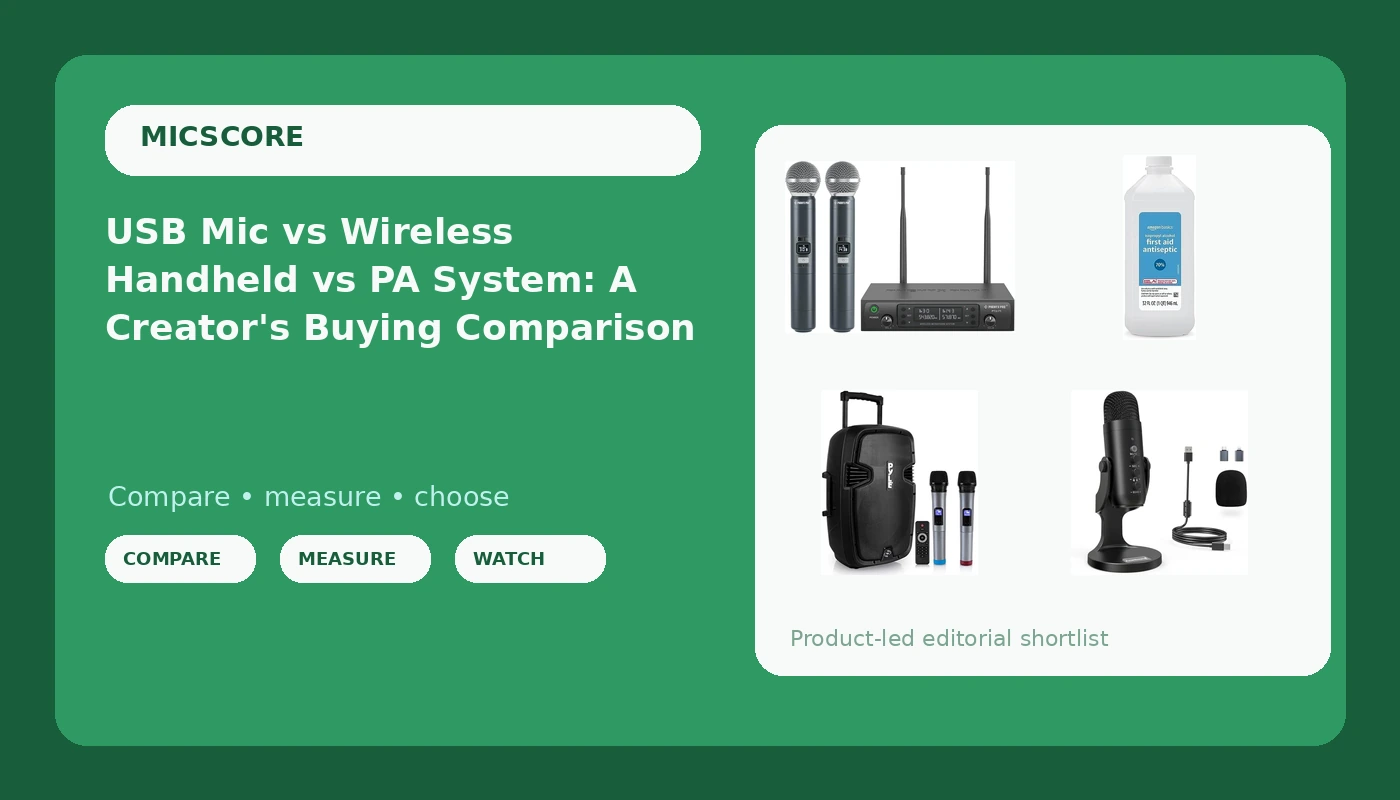
I have edited more than 4,000 episodes for other people, and the pattern never changes: the person with the worst room buys the most expensive microphone. So when a creator emails me asking for a podcast microphone comparison, I try to answer the question behind the question, which is never "which mic is best" but "which of these things do I actually need." Those are different questions, and the second one saves people hundreds of dollars.
The four items below are a strange set on purpose. One is a USB microphone you plug straight into a laptop. One is a dual wireless handheld system for two people. One is a portable PA speaker that ships with its own wireless microphones. And one is a bottle of isopropyl alcohol, which is the least glamorous thing in this article and the one I reach for most often. If you cannot tell which of these four jobs you are hiring for, that is the real problem, and this comparison is built to fix it before you spend anything.
The short version: if you record your own voice at a desk, the USB microphone is the right first purchase. If you ever hand a microphone to a guest, the wireless handheld system earns its place. The PA speaker is a room-filling tool for events and karaoke, not a recording device. And the alcohol stops being optional the first time a microphone goes near someone else's face.
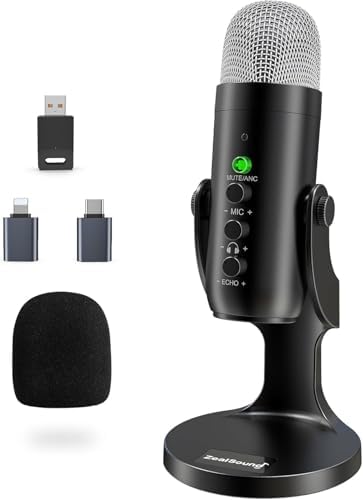
ZealSound Podcast Microphone for PC, Noise Cancellation USB Mic with Gain, Volume Adjustment & Mute Button, Monitoring & Echo, for YouTube, TikTok, Podcasting, Streaming, iPhone, iPad, Android, Mac
One cable from mic to laptop, gain and mute on the body, and it works with a phone as well as a computer. The fastest path to a usable voice track for one person
Still a USB mic in a real room. It hears the keyboard, the fan, and the wall behind your monitor, and "noise cancellation" is processing, not treatment
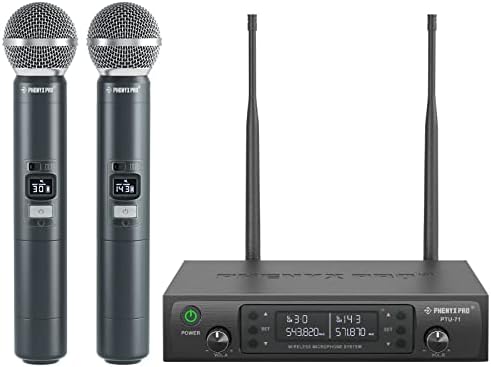
Phenyx Pro Dual UHF Auto Scan Handheld Wireless Microphone System PTU-71-2H
Two handheld transmitters and an auto-scanning receiver, so two people can talk with no cables and no frequency homework in a crowded building
Handheld technique is required, batteries need managing, and the receiver output still has to land in a mixer, camera, or recorder you already own
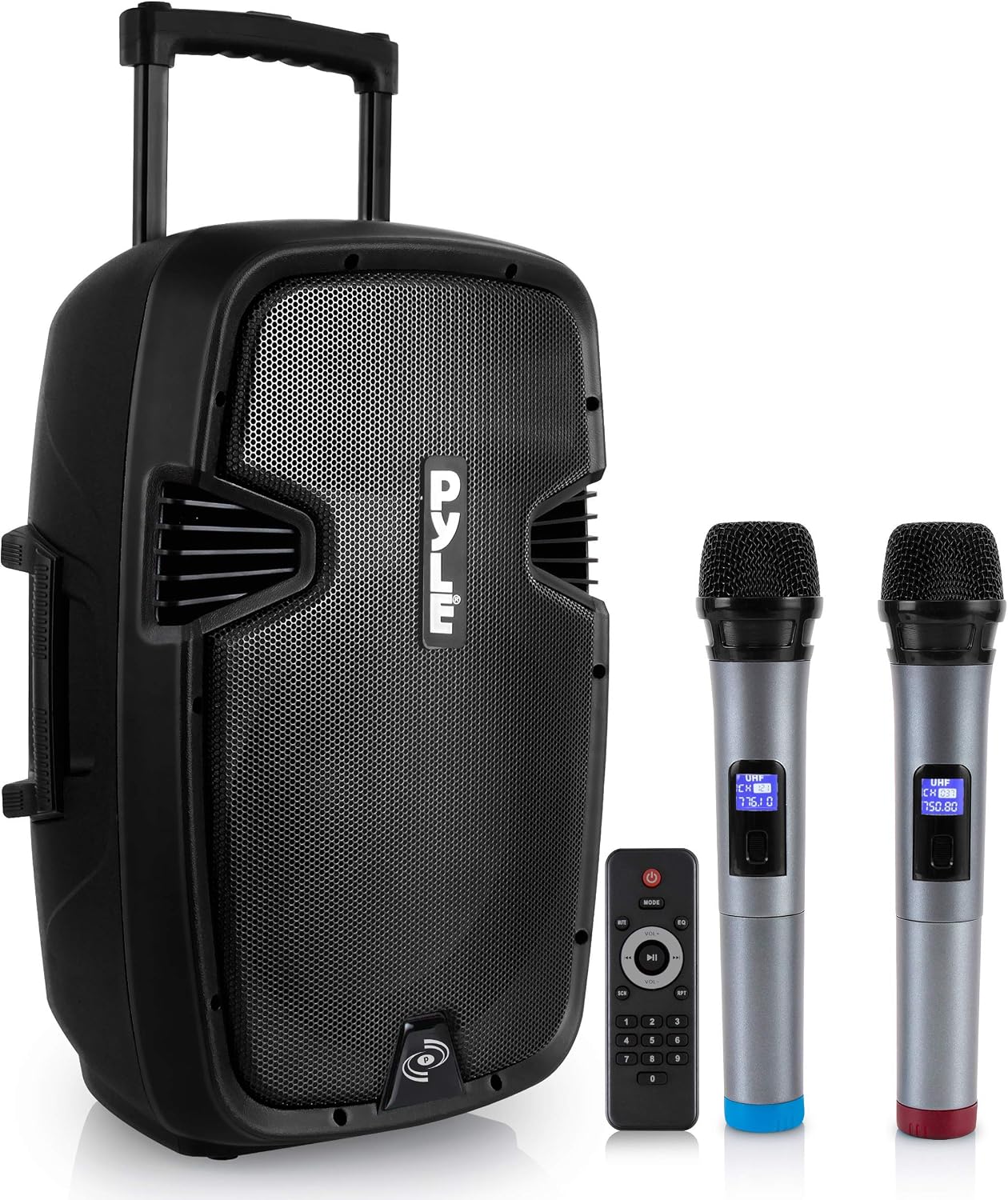
Pyle Karaoke Portable 15-inch PA Speaker System - 1600W Active Powered Bluetooth Compatible Speaker, Rechargeable Battery, Easy Carry Wheels, USB MP3 RCA, FM Radio, 2 UHF Microphone
Amplification, two wireless microphones, Bluetooth playback, a rechargeable battery, and wheels in one box. It is a party you can roll into a room
It is a speaker system, not a recording chain, and you pay for every one of those functions whether you need it or not
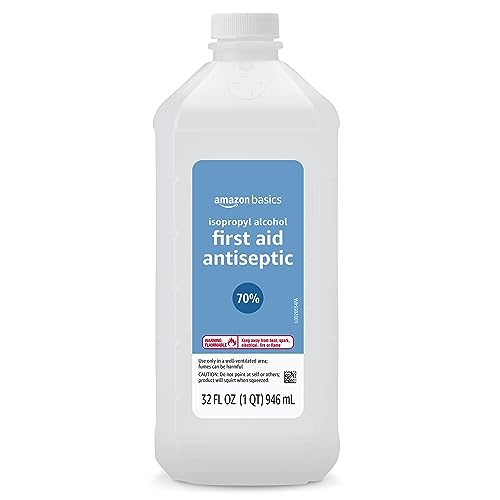
Amazon Basics 70% Isopropyl Alcohol First Aid Antiseptic for Treatment of Minor Cuts, Scrapes and Burns, Unscented, 32 Fl Oz (Pack of 1) (Previously Solimo)
The cheapest way to keep shared handheld microphones, grilles, and pop filters hygienic between users
Not a microphone, and not something that should ever get near a capsule, a connector, or open electronics
Prices and availability were captured from Amazon Creators API and may change.
What this comparison actually covers
These four products are not competitors. They are four different jobs, and most bad gear purchases happen because someone bought for the wrong job.
The first job is capturing one voice at a desk, cleanly, with the least possible friction. The second is putting a microphone in a second person's hand without running a cable across the room. The third is making sound loud enough to fill a space with people in it. The fourth is keeping the gear that touches faces actually clean. If you are honest about which of those you have, the rest of this article is straightforward, because the criteria barely overlap.
The criteria I use, in order: what sits between the mouth and the finished file, how many people are talking, how the signal leaves the microphone, and what the purchase drags in behind it. That last one matters more than the sticker, because a cheap microphone that needs a stand, a cable, and an interface is not cheap.
The desk microphone: ZealSound Podcast Microphone for PC
This is the one I would hand a new podcaster first. The supplied name describes exactly what it is: a USB microphone with gain, volume adjustment, a mute button, monitoring, and an echo control, aimed at YouTube, TikTok, podcasting, and streaming, and compatible with PC, iPhone, iPad, Android, and Mac. No interface, no preamp, no cable shopping. One USB connection and you are recording.
In practice, the parts that matter are unglamorous. Gain on the microphone body means you set your level at the source instead of hunting through software menus. A hardware mute button is worth more than it sounds, because a software mute depends on which application has focus, and the moment you need it is the moment you are least likely to check. Monitoring lets you hear yourself, which is how you learn to stop drifting away from the mic. The echo control is fun for a TikTok bit and I would leave it switched off for anything I had to edit later.
Here is the honest limitation, and it applies to every microphone in this class: the weak point is never the capsule, it is the room. A USB microphone sitting on a desk stand on a hard desk picks up keystrokes, mouse clicks, and the reflection off the wall behind your monitor. The noise-cancellation label means the microphone is processing the signal, not that your untreated kitchen has become a studio. Get this mic onto a boom arm, add a pop filter, keep it a hand's width from your mouth, and it will embarrass gear that costs several times more.
Check current Amazon price and see whether the bundle includes a stand, because that detail changes the real cost.
The wireless handheld system: Phenyx Pro PTU-71-2H
The Phenyx Pro system is two handheld transmitters and one receiver, with auto scan handling frequency selection. In a Brooklyn apartment building, where every wireless band is crowded with routers, doorbells, and neighbors, auto scan is not a luxury feature. It is the difference between a system you trust and a system you fight.
Where this wins is obvious the first time you record with a second person. Two people, two microphones, no cables, no one tethered to a desk, no one leaning into a shared condenser and breathing on it. Interviews, panel episodes, a co-host who paces while they think, karaoke, a live Q&A, a workshop, a small ceremony. A handheld dynamic is also forgiving in a way a desk condenser is not, because it rejects more of the room around it and rewards the person holding it for keeping it close.
Where it loses is everything around the microphone. Handheld technique is a skill: you have to keep it near the mouth and pointed at it, and guests will not do that without coaching. Batteries need to be fresh every session, and you need spares, because a dead transmitter mid-interview is a wasted hour. Most importantly, the receiver's output has to go somewhere, which means a mixer, a camera, or a recorder you already own. If you have none of those, this purchase does not stand alone the way the USB mic does.
Check current Amazon price before you commit, and count the batteries you will need on the same order.
The portable PA: Pyle Karaoke 15-inch system
The Pyle unit is a 1600W active powered Bluetooth speaker with a rechargeable battery, carry wheels, USB and MP3 and RCA inputs, FM radio, and two UHF microphones. Read that list again, because it tells you what this is: a complete event in a box. Amplification, wireless mics, playback, and power, all of it rolling on wheels.
That is genuinely useful for a specific kind of job. Karaoke night. An outdoor birthday. A school function. A small ceremony where you need a voice to reach the back row. A fitness class where the instructor has to be heard over music. For those uses, buying one thing that does all of it beats assembling a system out of five.
It is not a recording chain, and I want to be blunt about that, because I have heard the results of people trying. If you point a PA speaker at a room and record the room, you are recording a speaker, not a voice. A 15-inch PA speaker is loud by design, which means a shared handheld in a loud space is feedback waiting to happen, and the microphones that ship with a PA are built for announcing, not for a close, warm podcast voice. You are also paying for the amplifier, the battery, the radio, and the wireless mics at the same time. If you need only one of those four, you are overbuying in a way that a single-purpose purchase would not.
Check current Amazon price and be honest with yourself about whether you are amplifying a room or recording a show.
The consumable: Amazon Basics 70% Isopropyl Alcohol
This is the item people laugh at in a microphone comparison, and it is the one that ends up on every session checklist I write. It is exactly what the supplied name says: a 70% isopropyl alcohol first aid antiseptic, unscented, in a 32 fluid ounce bottle.
Why 70% and not something stronger: the general principle is that a higher concentration evaporates too quickly to do the job properly, while a 70% solution keeps enough water in the mix to stay on the surface long enough to be useful. That is why 70% is the standard for this kind of cleaning rather than the 91% bottle people grab because it sounds more serious.
In a studio, the job is shared gear. Handheld microphone bodies and grilles get wiped between users, pop filters get cleaned, tape residue comes off a boom arm, and a phone or tablet that gets passed around during a recording gets wiped down. When you are handing a wireless handheld to a guest, and then to the next guest, this is how you avoid turning your interview setup into a cold transmission service.
Two rules. Wipe, do not soak, and never let liquid near a capsule, a connector, or open electronics, including the USB microphone in this article. A slightly dampened cloth on the housing is the whole technique.
How I would spend the first $200
If you record alone, most of that budget goes to the USB microphone plus a boom arm and a pop filter. The arm and filter matter more than people expect: a microphone on a desk stand picks up everything the desk does, and no amount of processing removes typing from a track without damaging the voice too.
If you record with a guest, the wireless handheld system is the second purchase, and it solves a problem the USB mic cannot, which is a second person who needs their own microphone and cannot be tied to your desk. Budget for batteries at the same time.
The PA only makes sense if your problem is volume in a room full of people. If your problem is a file on a computer, it is the wrong tool, no matter how good the specifications look.
The alcohol is cheap enough that it belongs in the first order regardless of which path you take.
Trade-offs I would accept, and the ones I would not
I would accept the friction of handheld technique in exchange for off-axis rejection and two wireless channels. I would accept a single USB cable in exchange for losing the ability to swap microphones later. I would accept batteries in exchange for not tripping over a cable in front of a guest.
What I would not accept is buying a microphone you are afraid to use. If a setup is fussy enough that you skip recording sessions, the setup is the problem, and a simpler microphone you actually turn on every week will out-record an expensive one that stays in its case.
What I am watching next
USB microphones keep eating the entry market, and the software layer is where the fight is now. On-microphone processing, automatic EQ, and noise handling built into the mic itself will keep improving, and the brands that get the software right will win the next round. The other trend I am watching is room treatment selling as an accessory rather than a project, because the day people accept that the room is the microphone is the day half of these upgrade purchases stop happening.
Until then, match the tool to the job: a USB mic for your desk, a wireless handheld for your guest, a PA for the room, and a bottle of alcohol for everything that touches a face.