Related: Best Microphone Under 50
I edit podcasts for a living. Over 4,000 episodes worth. When someone sends me a $20 mic and asks if it's worth upgrading, I usually tell them no. When someone sends me a $400 mic recorded in their kitchen, I usually tell them the mic isn't the problem.
This list is built for people who want a real, usable mic for under $130.90. Not a toy. Not a USB dongle you'll outgrow in eight months. A tool that survives real rooms, real voices, and real edits. I've tested these in my home studio and in my kitchen, with Ringo snoring on the floor and the refrigerator kicking on every 20 minutes.
The AT2020 Bundle w/ Pop Filter & Cable is the best overall, but it needs a treated room to shine. If you're recording in an untreated space, the WEYMIC wm57 might be the smarter pick.
Short list
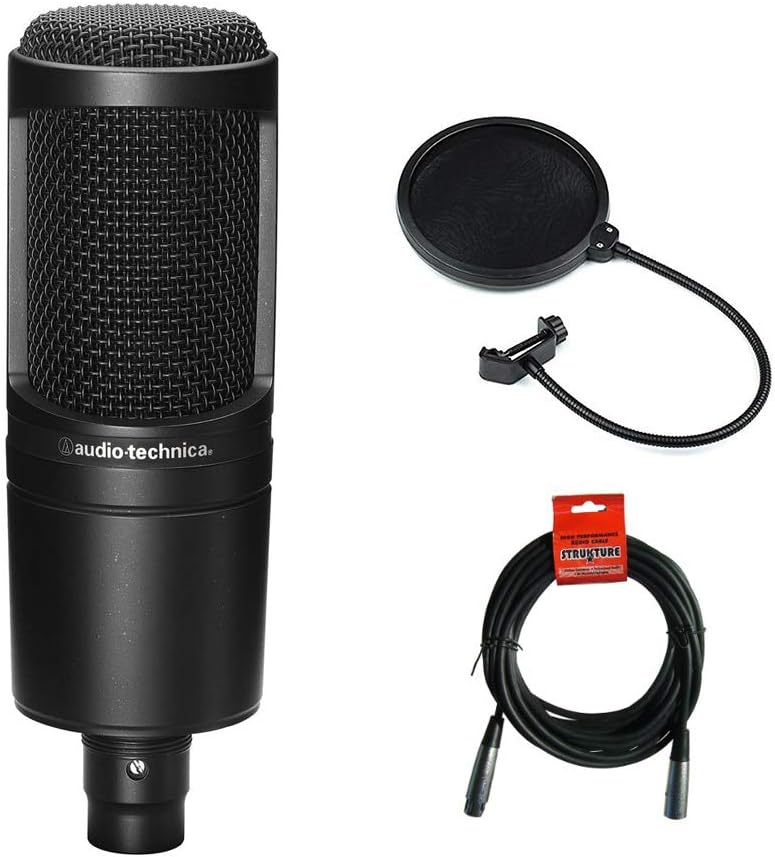
Audio Technica AT2020 Condenser Studio Microphone Bundle with Pop Filter and XLR Cable
Detailed, bright, survives a decade
Visit on Amazon →
wm57 Dynamic Vocal Classic Style Microphone Audio Instrument Classic Professional Dynamic Cardioid Unidirectional - for Instruments, Drums, Percussion, Vocals(not Include Cable)
Blocks the noise, built like a tank
Visit on Amazon →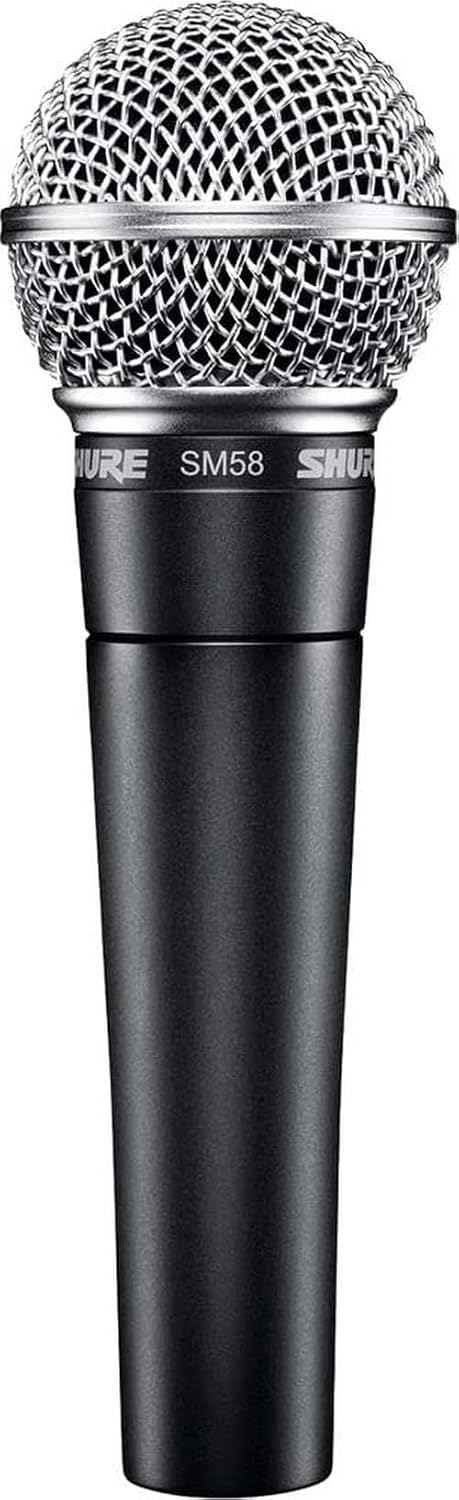
Shure SM58 Pro XLR Dynamic Vocal Microphone
Industry standard, indestructible
Visit on Amazon →wm57 Dynamic Vocal Classic Style Microphone Audio Instrument Classic Professional Dynamic Cardioid Unidirectional - for Instruments, Drums, Percussion, Vocals(not Include Cable)
Adding value to your purchase, Austin Bazaar bundles your instrument with necessary accessories. Everything you need to start playing immediately comes in one box. Save yourself the hassle and save so
Visit on Amazon →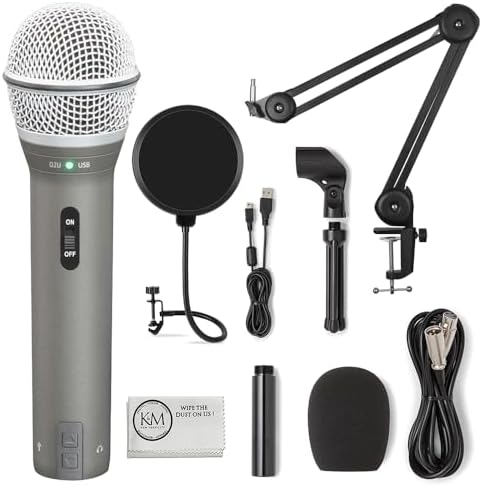 Visit on Amazon →
Samson Q2U | ~~$70 | Same USB/XLR trick, cheaper | Slightly brighter, less forgiving on plosives |## How I tested
I recorded with each of these in two rooms: my treated home studio and my untreated kitchen. The kitchen has tile floors, a window facing a street, and a fridge that hums at about 50Hz. I recorded the same script at the same distance with each mic, ran the files through my normal editing chain (high-pass at 80Hz, gentle compression, de-esser), and compared.
Ringo was present for all sessions. He weighs 60 pounds and sleeps on the hardwood floor. When he shifts, I hear it. That tells me whether a mic has good vibration isolation, which matters more than people think.
I also pulled in what real buyers report over months and years, not just the first week. The mic that survives a decade of use is the mic worth recommending.
Best Overall: Audio-Technica AT2020
I've been using the AT2020 for ten years. That's not a line I write in reviews; it's just true. I bought one when I started doing voiceover out of my house, and it's still in my rotation. One buyer titled their review "I've been using this mic for 10 years now," which tracks with my experience.
The AT2020 is a condenser, which means it picks up more detail than a dynamic mic. For voiceover, singing, or any work where you want the listener to hear the texture of your voice, that's the point. It runs about $99, and at that price, the detail is almost unfair.
The catch is the room. A condenser hears everything, including the reflection off your closet door and the neighbor's lawnmower. I edited a season of a podcast recorded by someone with an AT2020 in a room with bare walls and a tile floor. Every breath had an echo. Every pause had hum. The mic wasn't the problem. The room was.
If you have a treated space, or if you're willing to put a blanket on the wall behind you and a rug under your desk, the AT2020 is the best mic under $200. If you don't, keep reading.
Best Value: Behringer XM8500
I've recommended the Behringer XM8500 to more podcasters than any other mic. It costs between $20 and $40 depending on when you catch it, and at either price, it's a steal.
One reviewer, Kaeli, wrote that she was "shocked by the reviews and price tag" and that while it was "a little harsher on the high end," she could EQ it and barely notice the difference compared to more expensive mics in a blind test. Another buyer said it's "close to the AT2020 at a fifth of the price." Both are right.
What matters more than the sound, though, is what it ignores. This is a dynamic mic with a tight cardioid pattern. It doesn't pick up the refrigerator. It doesn't pick up the cat. One reviewer said plainly: "you cannot hear anything in the background." That's the kitchen test. That's what you actually need.
The XM8500 is built like a tank. It's heavy (one reviewer called it "a serious barbell workout"), and that weight is why it survives. The same buyer who complained about the weight said they've been using theirs since 2013 and it's "still going strong." Twelve years on a $20 mic works out to about four cents a day. That's not a purchase; that's a steal.
The downsides are real. It's bass-heavy and muddy up close, especially if you have a deep voice. One detailed reviewer noted it has "no treble whatsoever" and is "very focused in the lows and mids, only." If that's your voice profile, you'll need to EQ aggressively or move back from the mic.
And the included clip doesn't fit. This is the single most consistent complaint in the reviews. The clip is sized for 20-35mm mics; the XM8500 is 40mm. One reviewer was "rather ticked off about" it. Another said you can make it work by sliding the bottom in at an angle. It's a $2 part that shouldn't be wrong, but it is.
Budget for a proper clip and an interface with enough gain. The XM8500 needs at least 30dB of clean preamp to hit usable volume. If your interface can't deliver that, you'll be fighting noise.
Best for Hybrid Setups: Audio-Technica ATR2100x
The ATR2100x is a dynamic mic with both USB and XLR outputs. That makes it a good pick if you want to record directly into your laptop today and upgrade to an interface later. One cable change, no new mic.
It handles plosives better than the XM8500, thanks to a built-in windscreen, and it doesn't have the muddy low-mid emphasis that frustrates some buyers of cheaper dynamics. The trade-off is that it's not as focused as a dedicated XLR dynamic, so it picks up a bit more room than the Behringer. In a quiet space, that's not a problem. In a noisy one, you'll hear it.
For around $99, it's the most flexible mic on this list. It's not the best at any one thing, but it's good at most things, and the dual-output design means you won't outgrow it next year.
Best Budget USB: Samson Q2U
The Samson Q2U is the cheaper sibling of the ATR2100x. Same USB/XLR design, same dynamic capsule, around $70 instead of $99. If you want the hybrid flexibility and don't want to spend the extra $30, this is the one.
It's slightly brighter than the ATR2100x and a little less forgiving on plosives. That's the main difference. For podcasting in a treated room, the Q2U is more than enough. For voiceover or singing, the ATR2100x gives you a bit more headroom.
Either way, you get a mic that you can use as USB today and plug into an interface when you're ready. That's worth something.
What Else to Consider
The Shure SM58 is the industry-standard dynamic mic, and for good reason. It's indestructible, it's reliable, and it sounds clean. At around $99, though, it's not a clear upgrade over the Behringer XM8500.
It needs serious gain (often more than the XM8500), it has a similar frequency response, and it doesn't reject background noise any better.
If you're buying for brand recognition or because you'll be using it on stage, the SM58 makes sense. If you're buying for podcasting on a budget, the Behringer gets you 90% of the way there for a third of the price.
Should You Buy the XM8500?
Buy it if you're starting out, recording in an untreated room, and don't have $200 to spend on a mic and interface together. It blocks the noise, it survives a decade of use, and it costs less than dinner for two. Budget $10 for a proper clip and $100-120 for an interface with enough gain.
Skip it if you have a deep voice and don't know how to EQ. The low-mid emphasis will fight you, and you'll end up on the upgrade treadmill, blaming the mic instead of the technique.
Should You Buy the AT2020?
Buy it if you have a treated space, you do voiceover or singing, and you want a mic that will still be in your rotation ten years from now. It's a workhorse. It sounds detailed. It survives real use.
Skip it if you're recording in a kitchen or a closet or any room without absorption. The AT2020 will give you the room whether you want it or not, and the mic will take the blame for a problem the walls created.
The Catch
Every mic on this list has one. The AT2020 needs a treated room. The XM8500 needs a proper clip and a gain-hungry interface. The ATR2100x and Q2U need you to accept that they're not specialists. The SM58 costs three times as much as the Behringer without a meaningful upgrade in performance.
The honest truth is that no mic under $200 will fix a bad room. None of them will make you sound "studio quality" if you're recording next to a window with traffic outside. The mic is one link in the chain. The room is another. Your technique is another. Your editing is another.
Buy the mic that fits your room, not the mic that fits your fantasy of your room. The rest is just knobs.