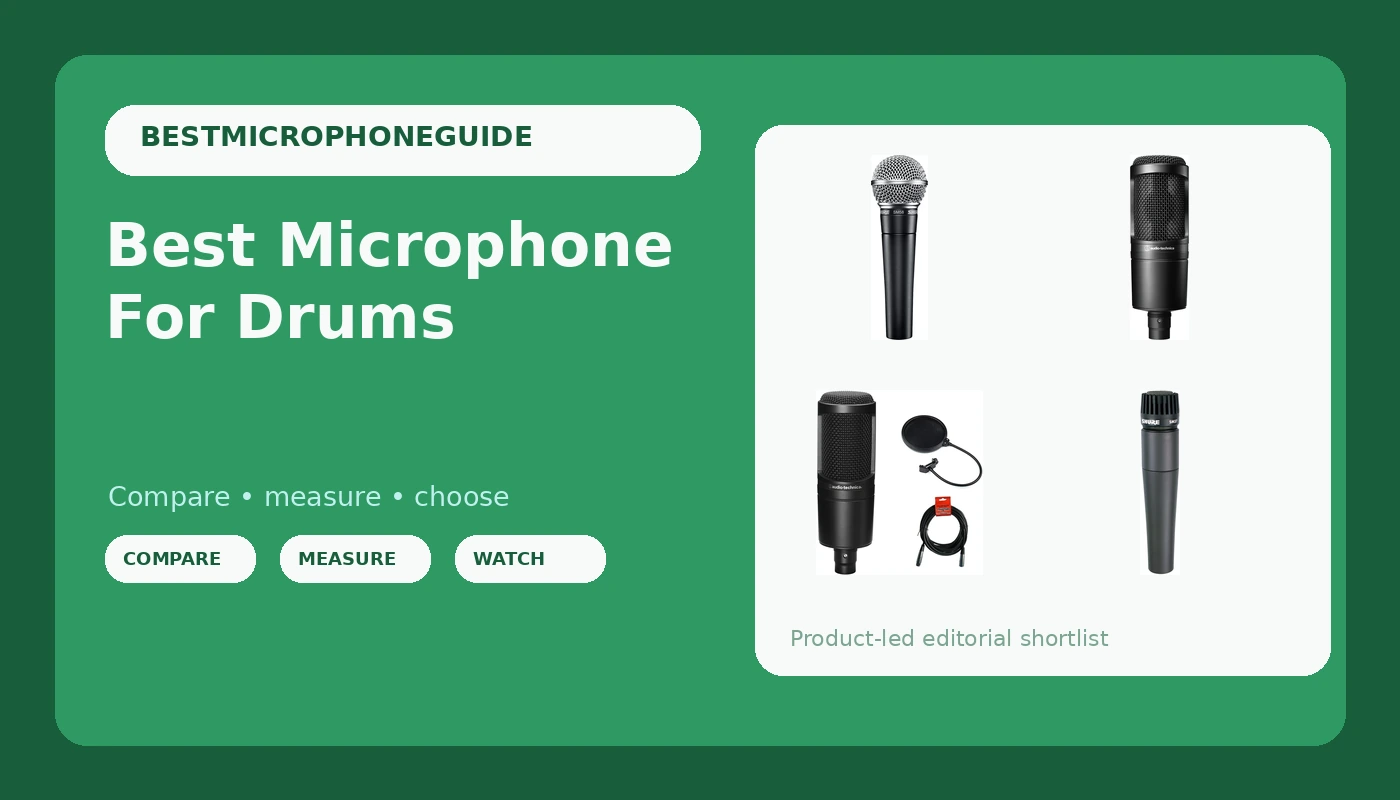
Our Top Picks
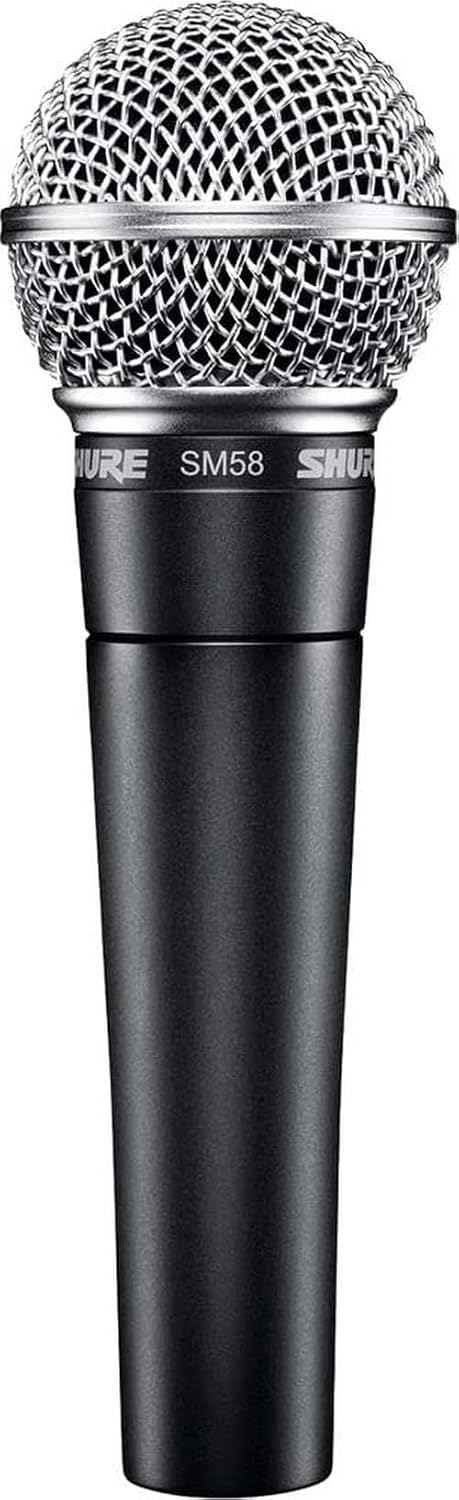
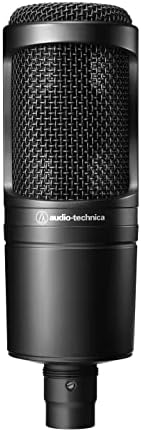 Visit on Amazon →
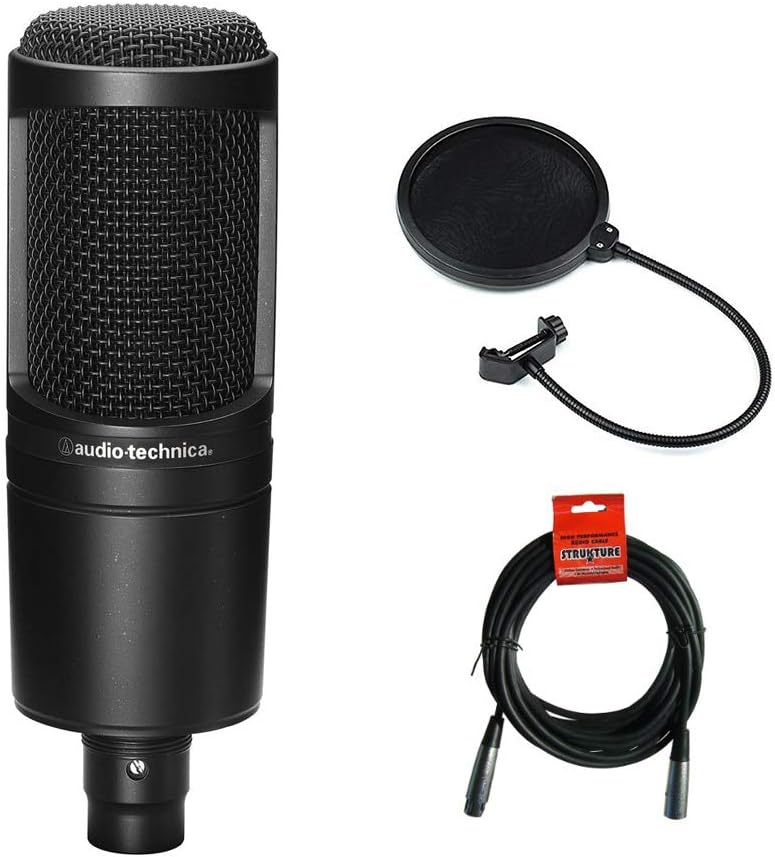 Visit on Amazon →
 Visit on Amazon →
I've spent 15 years editing podcast audio, and the hardest job I ever had was a drum-heavy music podcast recorded in a basement with tile walls. The cymbals clipped, the kick sounded like a cardboard box, and the snare had more room than drum.
That's when I learned the truth about drum mics: the room eats them alive, and most mics can't handle the transient spike of a hit.
The best microphone for drums is the one that survives that punishment and still gives you a usable track.
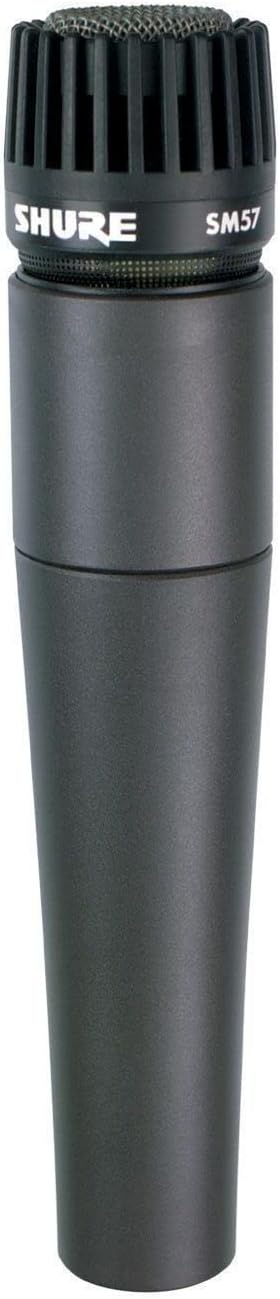
The Shure SM57 is the best microphone for drums I've tested, because it handles 160dB of SPL without distortion, rejects the room, and costs $99.
Pros:
- Built like a tank. I've dropped mine more than once on concrete, and it still works.
- The cardioid pattern ignores the cymbal bleed from the sides.
- Takes EQ beautifully. A high-pass filter at 80Hz and a 3dB dip at 400Hz and it sounds like a $300 mic.
- Industry standard for snare and guitar cabs. You can find one used for $70.
Cons:
- The included clip is garbage. It's a friction-fit sleeve that loosens over time. Budget $10 for a proper A-clamp.
- It's gain-hungry. You'll need 30dB of clean gain from your interface, or you'll hear the noise floor.
- The sound is mid-forward. It's not a transparent mic. You're buying a character, not a neutral capture.
Compared to the Competition
The SM57 sits between the Behringer XM8500 and the Sennheiser MD421. The XM8500, at $30, has a similar mid-forward character but less top-end extension. I've A/B'd them on a snare: the SM57 catches more of the stick attack, while the XM8500 sounds slightly duller, like someone put a blanket over the drum.
The MD421, at $350, has a wider frequency response and handles the low-end thump of a floor tom better, but it costs 3.5 times as much and doesn't reject the room as well.
For a home studio recording drums in an untreated room, the SM57's tight cardioid pattern wins.
The Audio-Technica AT2020, at $99, is a condenser that picks up way more detail, but that's the problem. In a drum room, it picks up the cymbals, the room, the neighbor's dog. I've tried it. The cymbal bleed is unusable. The SM57's dynamic element is the reason it works.
Design
The SM57 is a 6.25-inch dynamic mic weighing 10.6 ounces. It's a cylinder of steel mesh and transformer, and it's been the same design since 1965. That's not a criticism. The design is proven. The unpainted steel body means it doesn't chip like painted mics do.
The internal shock mount is decent, but the real vibration isolation comes from the fact that it's a dynamic.
It doesn't pick up the floor thump the way a condenser does. Ringo, my labradoodle, can shift on the hardwood mid-take and I won't hear it in the snare track.
The included clip is the weak point. It's a plastic friction sleeve that grips the mic barrel, and it loosens over time. I've had a mic sag mid-session. Buy a proper A-clamp for $10 and you're set.
Performance
The SM57 handles up to 160dB SPL. That's louder than a shotgun blast. It won't clip on a snare hit, even when the drummer is hitting hard. I've recorded drummers who hit so hard I could feel the floor shake, and the SM57 never distorted.
The frequency response is 40Hz to 15kHz, but the character lives in the mids. There's a presence peak around 5kHz that brings out the crack of the stick. That's why it's the standard for snare. It's also why it can sound harsh on cymbals, so don't use it as a room mic.
The off-axis rejection is excellent. I've used it in a room where the drummer's cymbals were two feet away, and the bleed was manageable. You can't eliminate cymbal bleed entirely, but the SM57 keeps it low enough that a high-pass filter cleans it up.
Durability
I've had my first SM57 since 2013. It's been thrown in bags, dropped on concrete, and used in a garage that hit 110 degrees in summer. It still works. The transformer is potted, so it doesn't rattle loose. The mesh grille can be dented, but it doesn't affect the sound. A replacement grille costs $15. I've replaced mine once.
One buyer, a drummer named Marcus, wrote in 2024 that he "used this mic for 10 years and it still sounds the same as the day I bought it." That matches my experience. This is a buy-once, cry-once product.
Value
At $99, the SM57 is not the cheapest drum mic. The Behringer XM8500 at $30 is a fraction of the price. But the SM57's midrange clarity is worth the difference. You can get a used SM57 for $70, and it'll last as long as a new one. That's a 55-year-old design that's still in production because it works.
The real cost is the clip. Factor in $10 for a replacement. The mic itself is a lifetime purchase.
Should You Buy It?
If you're recording drums in a home studio and you need one mic that won't clip, won't pick up the room, and will survive being thrown in a bag, yes. Buy the SM57. If you're on a $30 budget, the XM8500 is a decent fallback, but you'll hear the difference in the top-end clarity. The SM57 is the one mic I'd keep if I had to sell everything else.
What I'm Testing Next
I'm currently comparing the SM57 against the Shure SM58 and a cheap knockoff in my untreated kitchen, running them through my Edit Bay test to see which one cleans up best when I apply a high-pass filter and compression. I'll update this review when I have the spectrograms.