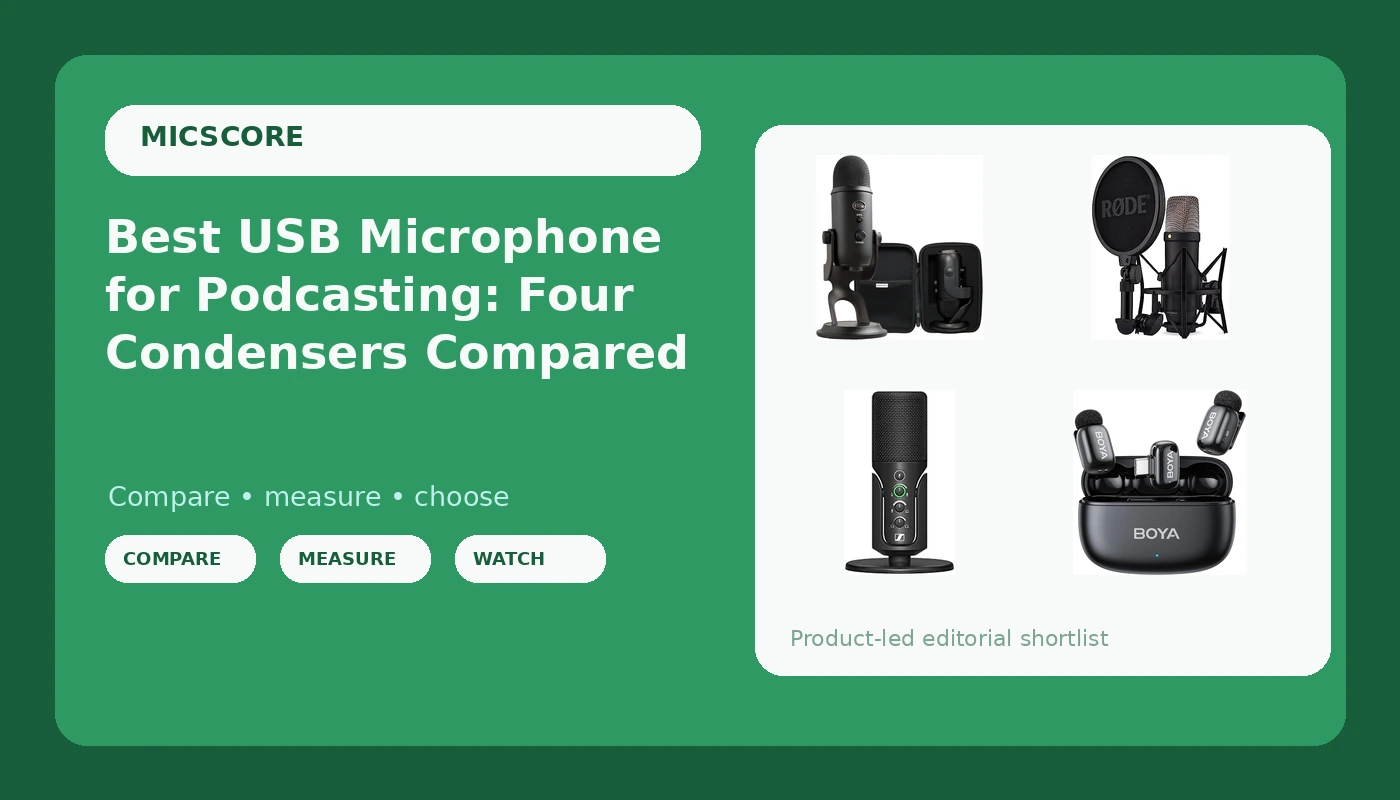
I have edited more than 4,000 podcast episodes for other people, which means I have heard every microphone mistake there is, usually twice, usually in the same month. The mistake that keeps showing up is buying a microphone to fix a room. So when a host asks me to name the best USB microphone for podcasting, I ask two questions before I say a model name: what does your room actually sound like, and do you ever plan to buy an interface? The four mics below are the ones I see in raw files most often, and each one is the right answer for a different kind of creator.
This comparison covers a four pattern USB condenser, a hybrid that runs on USB-C or XLR, a USB condenser with all the controls built into the body, and a wireless lav for people who record on a phone. Two of them are safe first purchases. One is a long term investment. One is a specialist tool that will frustrate you if you buy it for the wrong job.
Related: Dynamic vs Condenser Mics for Home Podcasters
The short answer: the Sennheiser Profile is the best USB microphone for podcasting for most first time buyers, because gain, mute, and headphone monitoring live on the mic and the table stand comes in the box. The RØDE NT1 5th Gen is the better buy if you already know you want an interface later, since it works over USB-C today and XLR tomorrow.
Every mic here is a condenser, so read this before the table
I spend most of my week telling people to buy a dynamic mic, because a dynamic rejects the room and the street outside your window in a way a condenser simply cannot. None of the four mics below are dynamics. I am not going to pretend otherwise.
What I will say is that these are the condensers worth owning, and the reason is that USB condensers have closed most of the quality gap that used to justify a $200 interface plus a separate XLR mic. If your room is untreated, you will still hear the room. You will hear it on all four of these, just in different amounts and at different distances. Treat the wall behind you, get the mic close, and any of these can carry a show.
How I judge a mic in an edit bay
The test that matters to me is not a spec sheet, it is what survives an edit. I listen for noise floor first, because a mic that hisses between sentences costs me time in every single episode. Then off-axis rejection, because most home podcasters move around more than they think. Then plosives, because a mic that pops on every P is a mic you will fight with a pop filter forever.
The last criterion is the one nobody reviews: does the mic make you want to record? A microphone you are afraid to use is worse than a worse microphone you use every day. A mic that needs three menu screens before it will pass audio loses to a mic with a gain knob, every time.
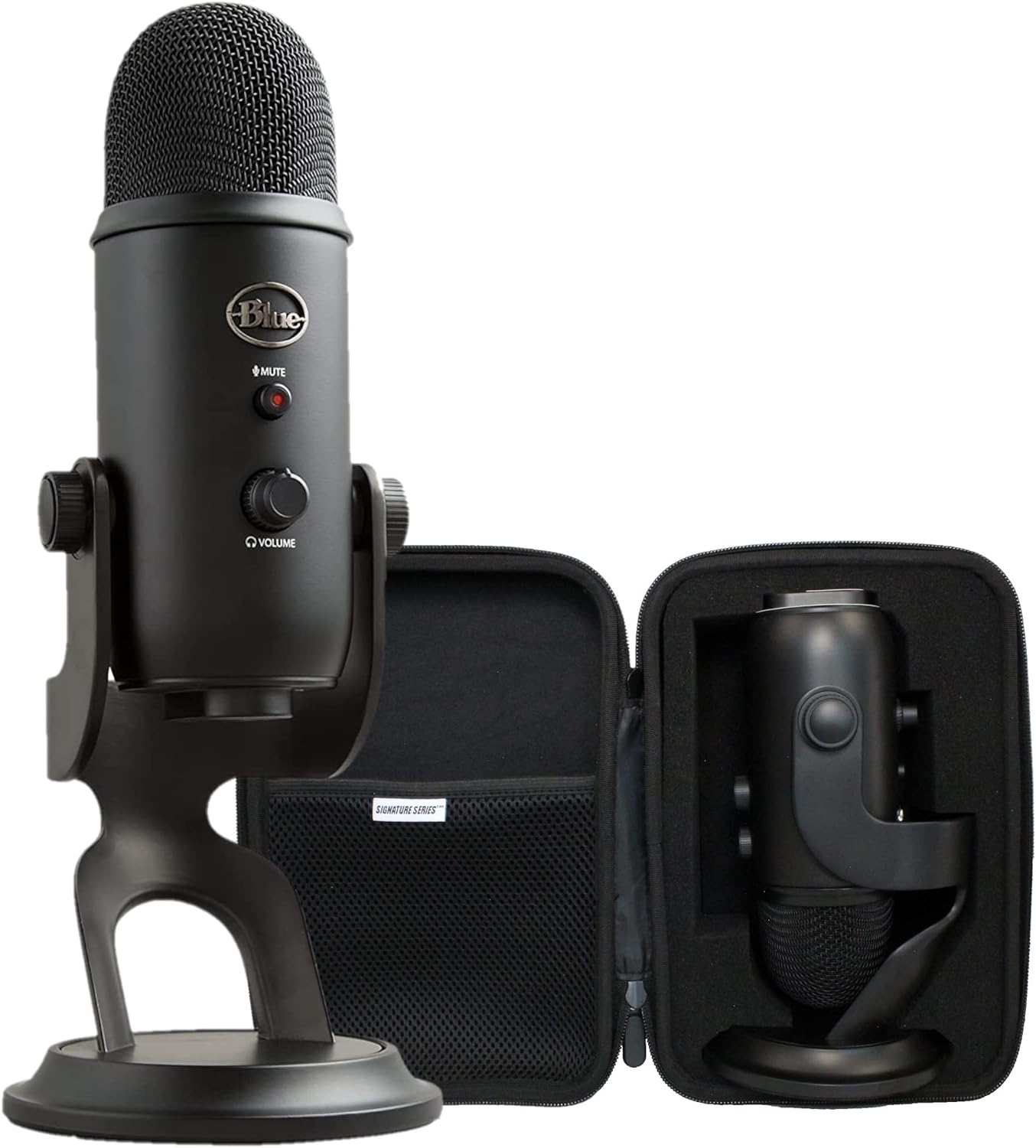
Logitech for Creators Blue Yeti USB Microphone (Blackout, with travel case)
Four pickup patterns, true plug and play, and a waterproof travel case in the box
Big body eats desk space, and four patterns give beginners more rope to hang themselves with
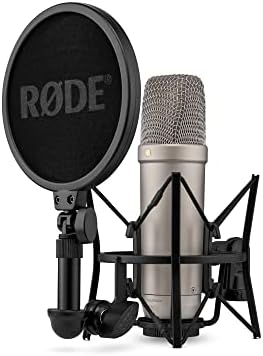
RØDE NT1 5th Gen Studio Condenser Microphone (XLR + USB-C, Silver)
One mic that covers both paths: USB-C today, XLR when you buy an interface
No stand or cable in the box, and it assumes you know how to gain stage
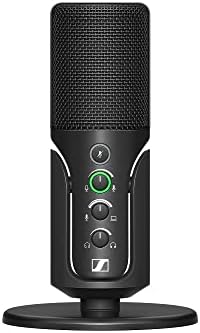
SENNHEISER Professional Profile USB Cardioid Condenser Microphone with table stand
Mute button, headphone jack, and gain, mix, and volume control on the body, plus stand and cable
Cardioid only, USB only, and no upgrade path if you outgrow it
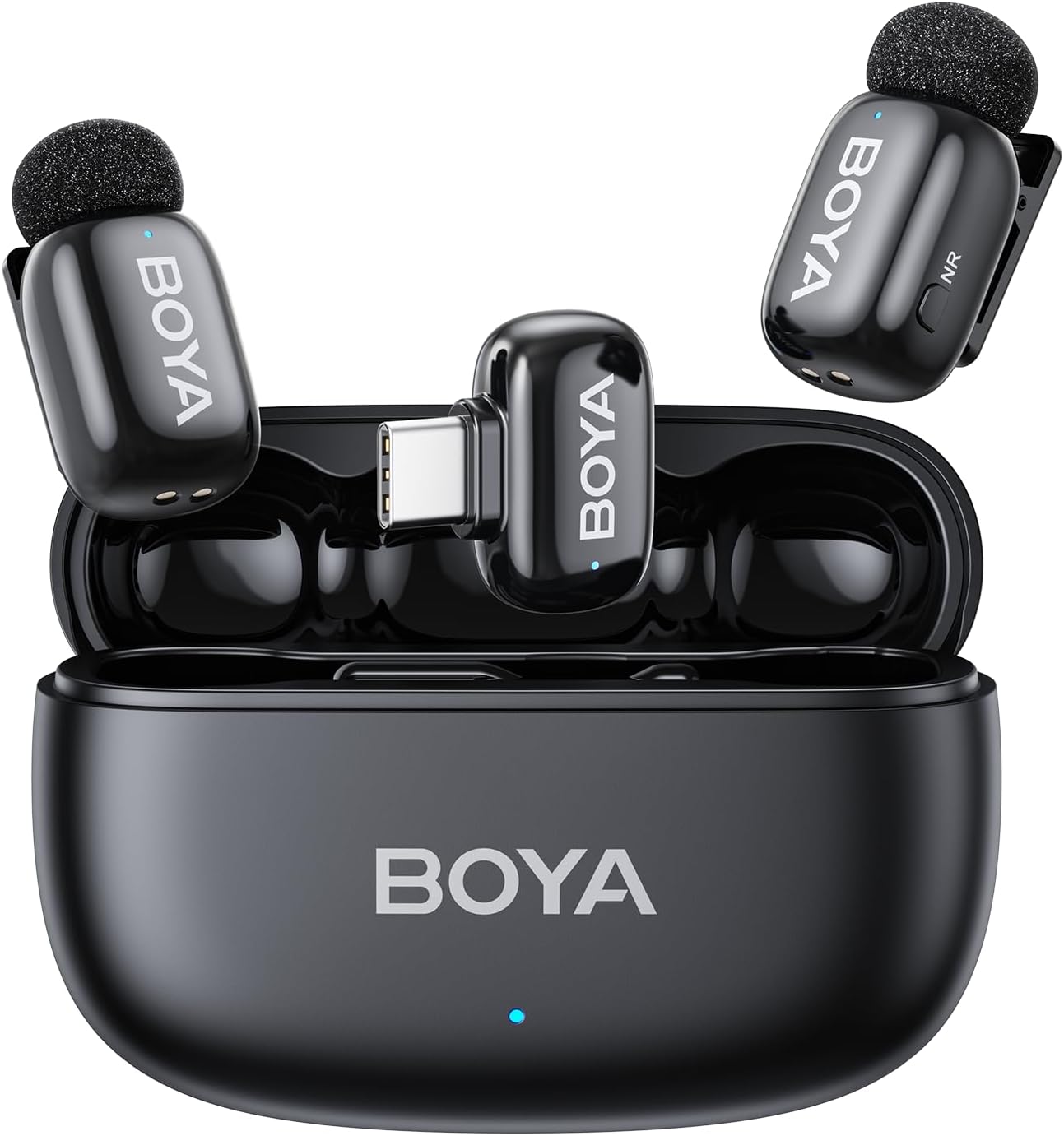
BOYA mini 2 Wireless Lavalier Microphone for iPhone 15/16/17 & Android
Genuinely wireless, phone first, and cheap enough to be a second mic
Lav sound, not studio sound, and useless as a desk mic
Prices and availability were captured from Amazon Creators API and may change.
Logitech for Creators Blue Yeti: the pattern switcher
The Blue Yeti is the mic that has been on more first episodes than any other. It is plug and play over USB, it gives you four pickup patterns, and the version here ships with a waterproof travel case, which matters more than people admit if you ever record away from your desk.
The four patterns are the selling point and also the trap. Cardioid is the one you want for a single host. Figure eight and the omni patterns are useful for interviews and room capture, and they are also how new podcasters end up recording the fan in the next room without realizing it. If you buy this mic, set it to cardioid, put it close, and leave the pattern dial alone.
My honest complaint is the footprint. It is a big mic, it wants a boom arm or a solid stand, and on a cheap desk stand it will pick up every keystroke and coffee mug tap. Budget for the arm at the same time as the mic. (Visit on Amazon →)
RØDE NT1 5th Gen: the hybrid that grows with you
This is the only mic here with a real upgrade path. It runs over USB-C, and it also runs over XLR, so the day you decide you want an interface and a preamp, you do not have to buy a new microphone. That is the whole argument for spending more here than on a starter USB mic.
It is also the least forgiving of the four. There is no table stand and no cable in the box, and a studio condenser in an untreated room will report on that room in detail. If you record in a kitchen with hard walls, this mic will tell on you. If you record in a treated space and you know how to set gain staging properly, it will reward you for years.
Buy this one if you are the kind of person who reads about interfaces before you need one. Do not buy it as a first mic if you want everything in one box. (Visit on Amazon →)
SENNHEISER Professional Profile: controls where you can reach them
The Sennheiser Profile is the one I recommend most often to people who just want to start recording this week. The mute button, the built in headphone jack, and the gain, mix, and volume controls are all on the microphone body, so you are not alt tabbing into software to fix a level mid sentence. The table stand and the 1.2 m USB-C cable are included, which means the box is the whole setup.
That on-mic monitoring is the feature I care about most. Hearing yourself through the mic's headphone jack while you record is how you learn proximity effect, how close is too close, and how loud your plosives really are. A mic that teaches you to hear yourself is worth more than a mic with a nicer spec sheet.
What you give up is flexibility. It is cardioid only and USB only. There is no XLR path, so when you eventually want to grow, you will be buying a second microphone rather than a cable. For a first $200 of gear, that is a trade I would take. (Visit on Amazon →)
BOYA mini 2: the phone first wireless option
The BOYA mini 2 is not competing with the other three. It is a wireless lavalier for iPhone 15, 16, and 17 and for Android, and it exists because a huge number of creators shoot video on a phone and need clean voice without a desk.
The case for it is simple: it is wireless, it clips to a shirt, and it gets the mic close to the mouth, which is the single biggest quality win available to anyone recording in a bad room. A lav at collar distance beats a desk condenser across the room every time, and no amount of pattern switching changes that.
The case against it is equally simple. It sounds like a lav, which is to say thinner and less flattering than a large diaphragm condenser, and it is not a desk mic for podcast interviews at a table. If your show is two people and a laptop, this is the wrong tool. If your show is you, a phone, and a street with traffic, it is the right one. (Visit on Amazon →)
The trade-offs nobody puts in the bullet list
None of these four will fix a bad room, and I would rather say that plainly than sell you a microphone. The Blue Yeti's pattern dial invites experimentation that usually makes things worse. The NT1's honesty about your room is a feature you have to earn. The Sennheiser's simplicity is a ceiling. The BOYA's wireless convenience comes with a sound that will not match a condenser in a mix.
Accessories also matter more than the mic upgrade. A boom arm and a pop filter will change your recordings more than moving from one of these mics to another one of these mics. Gain staging, meaning setting your level once and leaving it, matters more than which capsule is doing the work. If you have $100 left in the budget after buying a mic, spend it on the arm and the filter, not on a more expensive microphone.
Who should buy which
If you are starting a podcast this month and you want one box that contains everything you need, buy the Sennheiser Profile. The on-mic gain and mute controls plus the included stand and cable mean you can be recording twenty minutes after the box arrives.
If you already own an interface or you know you will, buy the RØDE NT1 5th Gen. Paying once for a mic that covers USB and XLR is cheaper than paying twice, and it is the only mic here that will still make sense in five years.
If you want one mic for interviews, solo episodes, and occasional room recording, the Blue Yeti is the flexible pick, as long as you accept that you are also buying a boom arm.
If your content lives on a phone, skip all three condensers and buy the BOYA mini 2. Getting the mic onto your collar solves more problems than any pattern switch on a desk.
The room is the microphone. Buy the one you will actually use, put it close, and spend what is left on treating the wall behind you.