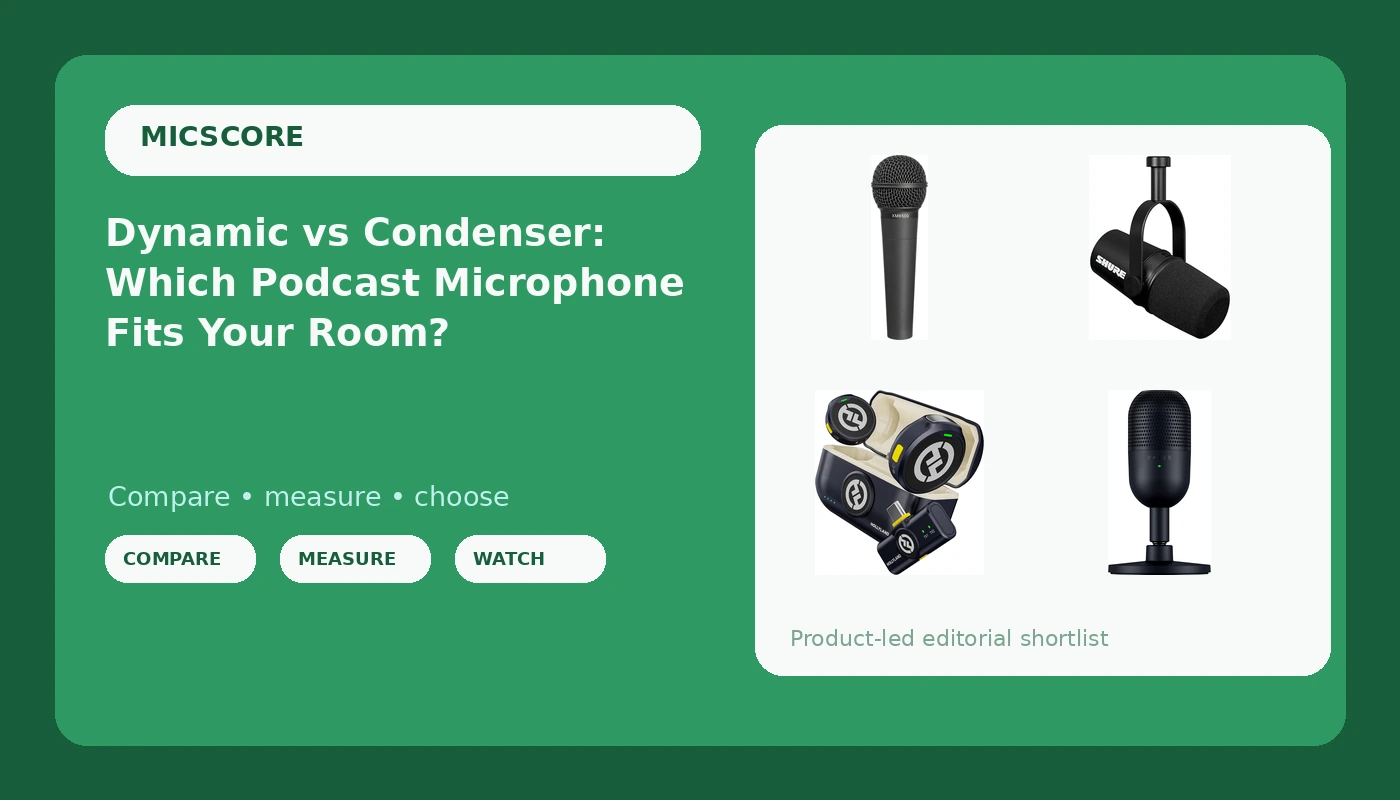
Choosing a podcast microphone for home studios is less about brand names than about the room you actually record in. A treated closet and a bare kitchen wall push you toward different tools, and the four mics below cover the realistic spread: an XLR dynamic built for voice, a cardioid wired workhorse, a compact USB condenser that plugs straight into a laptop, and a wireless lav kit for shooting video on a phone. This explainer walks through what each one is for, what a spec sheet does and does not tell you, and how to pick without buying gear you will never use.
Related: How to Treat a Small Home Studio Without Foam Panels →
Quick answer
If you record voice at a desk and already own an audio interface, start with an XLR dynamic microphone. Its design favors what sits directly in front of it, which matters in a room you have not treated. If you want one cable into a laptop and nothing else to buy, a USB microphone gets you recording the same afternoon. If your videos live on a phone, a wireless lav kit solves a distance problem rather than a tone problem: it puts the capsule near your mouth while the camera stays on its tripod.
Four useful options
| Model | Best fit | What stands out |
|---|---|---|
| Shure MV7X XLR Dynamic Podcast & Recording Microphone - Black | Desk podcast and voiceover in an ordinary room | XLR-only dynamic built for speech, no USB output |
| Behringer XM8500, Wired Microphone, Cardioid, 20dB, 3000Hz, 1000Hz, 1000mV, 1000nV, 1000pV, 1000Typ, 1000W | A first XLR microphone on a tight budget | Cardioid wired body, the lowest entry point here |
| Razer Seiren V3 Mini USB Microphone, Supercardioid Condenser Mic, Black | One-cable USB recording at a desk | Supercardioid condenser capsule in a small USB body |
| Hollyland Lark M2 Wireless Microphone for iPhone15/16/17&Android, USB C Mini Lapel Microphone Wireless, 1000ft Range, Hi-Fi Audio, Noise Cancellation, 30H Battery for Video Recording, Streaming | Phone and camera video, talking-head shoots | Listed 1000ft range, noise cancellation, and 30H battery |
The voice-first XLR dynamic: Shure MV7X
This is the one to consider if you already own an interface, or if you have decided the interface path is where you are heading. It has no USB output, which means the purchase is only half a setup: you still need a preamp with enough clean gain and a cable. That is not a flaw, it is the trade. In exchange you get a dynamic capsule that responds less to the fan, the street, and the refrigerator than a condenser typically will. Plan on a boom arm and a pop filter, keep the mic close, and use the proximity effect on purpose rather than by accident. Distance is the variable that changes tone most in a small room.
The budget XLR starter: Behringer XM8500
Handheld cardioid mics like this are the quiet workhorses of the format. They reject a useful amount of off-axis sound, they tolerate being talked into at close range, and they do not ask for much from a modest preamp. The catch is everything around them. A handheld on a desk stand transmits every keystroke and every bump straight into the capsule, so a boom arm and a pop filter matter more here than any upgrade you could buy later. If you are assembling a first setup, budget for the mount and the cable at the same time as the microphone, not six months afterward.
The compact USB mic: Razer Seiren V3 Mini
The supercardioid pattern is the interesting part. It is narrower than cardioid, so it hears less of what is behind and beside the capsule, which helps in a shared room. The counterweight is that condensers are simply more sensitive than dynamics, and a desk-mounted condenser hears the keyboard, the mouse pad, and the laptop fan with great enthusiasm. Point it at your mouth, keep your hands off the desk while you talk, and get it on a boom if you can. If your recording space is genuinely quiet and you want the fastest possible path from unboxing to a published episode, this is the category that gets you there.
The wireless lav kit: Hollyland Lark M2
This is not competing with the desk mics above, it is solving a different problem. A lav gets the capsule inches from your mouth regardless of where the camera is, which is why it wins for walking shots, demonstrations, and anything filmed away from a desk. The trade-offs are physical: clothing rustle, a clip that moves, wind outdoors, and a battery you have to remember. The listed 1000ft range and 30H battery are marketing figures from the product page, not measured results, so treat them as upper bounds rather than expectations. Test the system in your own space before you rely on it for a paid shoot.
Prices and availability may change. Product images, names, and retailer links are matched to verified listings. No current price, rating, stock status, or measured result is stated here without current evidence.
Why your room beats your microphone
Every microphone records two things: the sound arriving at the capsule and the sound of the space it is sitting in. In an untreated bedroom, that second ingredient is the one that ruins takes. A condenser picks up more of it because it is more sensitive and usually further from your mouth. A dynamic picks up less of it because it needs to be close and its design favors what is right in front of it. That single difference explains most of the advice in this article, and it explains why upgrading from a cheap dynamic to an expensive condenser in a bad room often makes a recording sound worse, not better.
The practical version is simple. Stand in your recording spot and clap once. If you hear a ringing tail, a flutter, or an obvious boxy note, that is the room talking, and no microphone fixes it. Moving a mic closer to your mouth, hanging a blanket behind you, and turning off the refrigerator do more for intelligibility than any capsule swap. This is why the cheapest mic here can beat a much more expensive one: proximity and pattern matter more than price when the room is the weak link.
Reading a spec sheet without getting fooled
Frequency response graphs sell microphones, and they tell you almost nothing about whether a mic will work in your apartment. A response curve describes output across the audible range under controlled conditions. It does not tell you how much street noise reaches the capsule, how the mic behaves two inches from your mouth versus twelve, or whether it will pick up the hum from your laptop charger. Sensitivity and self-noise numbers are similarly narrow: useful for comparing two mics on the same interface, not for predicting how a recording will sound in your kitchen.
What actually predicts success is pattern, distance, and gain staging. Pattern decides what the mic hears besides you. Distance decides how much of the room arrives with your voice. Gain staging decides whether you are amplifying a clean signal or turning up a noisy one. Get those three right and a modest microphone sounds professional. Get them wrong and the most expensive microphone in the catalog will still deliver a recording full of room tone.
- Measure your room before you buy. Clap, listen, and note the noise sources you cannot remove, such as a street, a fan, or a shared wall.
- Decide the connection first. USB means one cable and no interface; XLR means an interface, a cable, and enough clean gain.
- Match the pattern to the space. Cardioid and supercardioid reject more of the room than an omnidirectional capsule, and tighter patterns help in untreated rooms.
- Budget for the mount and the filter. A boom arm and a pop filter change a recording more than a modest mic upgrade does.
- Record a test before you commit. Two minutes of speech, headphones on, and listen for plosives, hum, and room reflections before you build a workflow around it.
Practical guidance for your first podcast microphone setup
- Put the microphone close and slightly off to one side of your mouth. This reduces plosives and uses the proximity effect instead of fighting it.
- Treat the wall behind you first. A moving blanket, a bookshelf, or a closet full of clothes is more effective than foam on the wall in front of your face.
- Set gain so your loudest moment peaks with headroom to spare, then leave the knob alone. Riding the gain mid-sentence creates more problems than it solves.
- Kill the obvious noise sources before you touch any software: fans, air conditioners, phone notifications, and the laptop charger buzzing on the same circuit.
- Pick one microphone and learn it for a month. Placement, distance, and speaking habits improve a recording faster than a new purchase does.
Which option should you choose?
Choose the Shure MV7X XLR Dynamic Podcast & Recording Microphone - Black when you already own an interface or plan to buy one and you record voice at a desk in a room you cannot treat. Choose the Behringer XM8500, Wired Microphone, Cardioid, 20dB, 3000Hz, 1000Hz, 1000mV, 1000nV, 1000pV, 1000Typ, 1000W when you want to start on the XLR path at the lowest cost and you are willing to budget for a boom arm and a pop filter. Choose the Razer Seiren V3 Mini USB Microphone, Supercardioid Condenser Mic, Black when you want a single cable into a laptop and your space is quiet enough for a sensitive capsule. Choose the Hollyland Lark M2 Wireless Microphone for iPhone15/16/17&Android, USB C Mini Lapel Microphone Wireless, 1000ft Range, Hi-Fi Audio, Noise Cancellation, 30H Battery for Video Recording, Streaming when your video is shot on a phone or camera and the microphone has to travel with you.
One caveat applies to all four: the differences between them shrink considerably once placement and room treatment are handled, and they grow considerably when they are not. Nothing here is a measured comparison, and the wireless kit's range and battery figures come from the product listing rather than from independent testing.
The bottom line
The right microphone is the one that fits your room and your workflow, not the one with the longest feature list. If you record voice at a desk and can live with an interface, a dynamic XLR microphone is the safer long-term choice because it forgives an untreated space. If you want to start recording today with one cable, a USB microphone removes every excuse. If your audience watches rather than listens, a wireless lav kit puts the capsule where it belongs and lets the camera stay on its tripod. Buy the mount, kill the background noise, and spend a month learning the microphone you already have before you think about the next one.