Related: Dynamic or Condenser: How to Pick a Microphone for the Room You Have
I have edited more than 4,000 episodes for other people, and the thing that ruins most of them is not the microphone. It is the room. A USB podcast microphone can sound like a $1,000 microphone in a soft room and like a $30 microphone in a kitchen with tile and a refrigerator humming behind the host, and no spec sheet will tell you which one you own.
That is the lens I use for every mic on this page. The four here are the ones I would put in front of a new podcaster, a streamer, or someone who shoots video and talks at the same time. What separates them is not frequency response. It is how much of your apartment they let in, and whether you will still be using them in a year.
I keep spectrograms of every mic that comes through my studio, and I record each one twice: once in the treated room where I do voiceover, and once in my untreated kitchen, because the kitchen is where most people actually record. This page is the short version of that notebook.
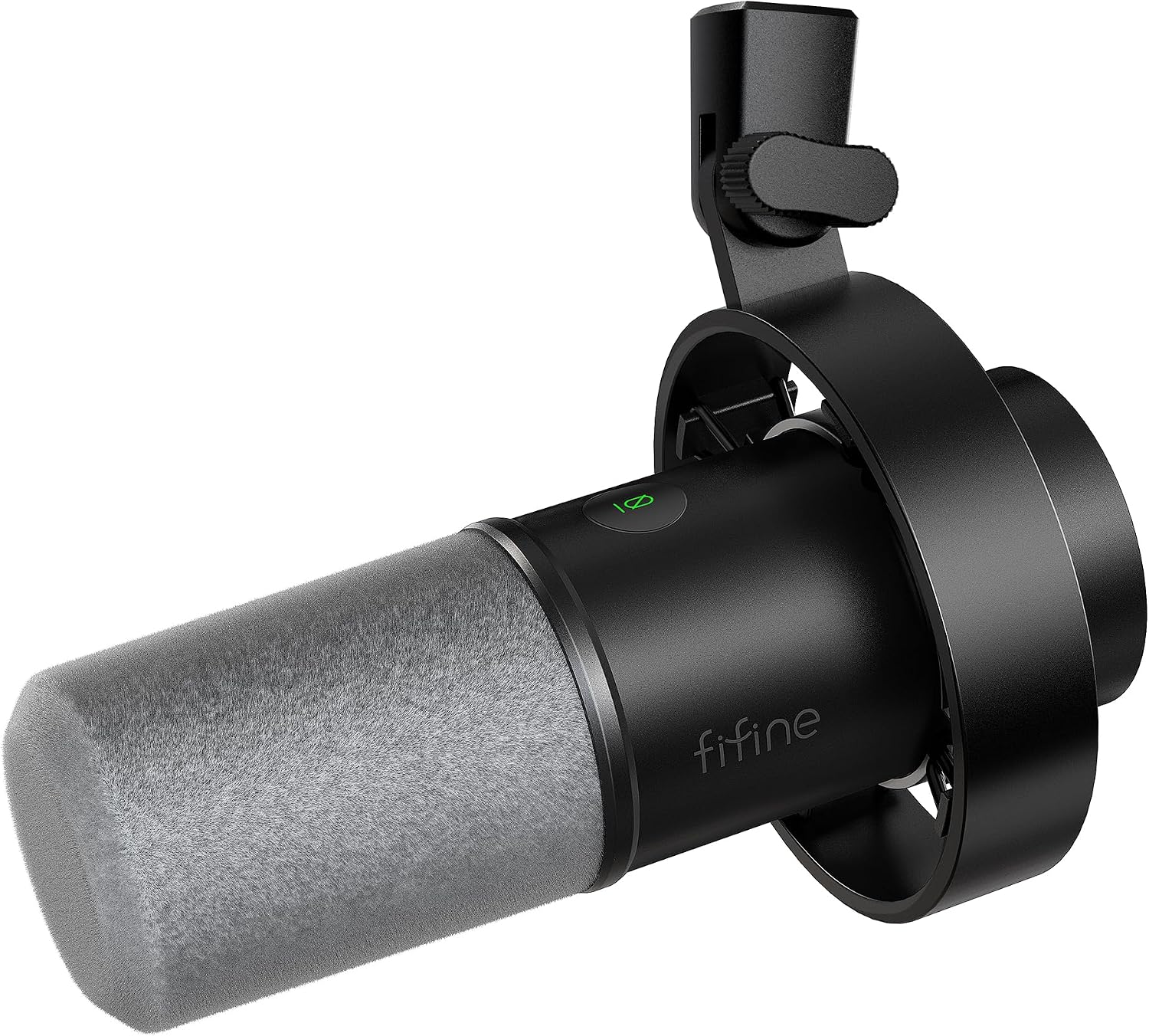
The Mic Most People Should Buy First: FIFINE AmpliTank K688
The AmpliTank K688 is a dynamic microphone with USB and XLR outputs, and that combination is why it leads this page. Dynamic microphones are less sensitive to the room than condensers, which is the only specification that matters if you record in an apartment with a street outside the window.
The USB half means you can plug it into a laptop and record tonight without buying an interface. The XLR half means that when you eventually want a mixer or an interface, the mic comes with you instead of going into a drawer. That is the upgrade path most home podcasters should be on, and very few of them need to leave it.
Dynamics also need you closer to the capsule than condensers do. That is the proximity effect working in your favor: at three or four inches, your voice is loud at the capsule and the room is comparatively quiet. Off-axis rejection does the rest of the work. A car door slamming outside arrives at the side of the mic, and a dynamic is far less interested in it than a condenser would be.
The things I would change are not the microphone. Get it off the desk. A desk stand transmits every keystroke, every mouse click and every bumped coffee cup straight into the recording, and a decent boom arm fixes more problems than a more expensive mic does. Add a pop filter, watch your plosives, and set your gain so normal speech peaks well below clipping. Then leave the settings alone and go record twenty episodes.
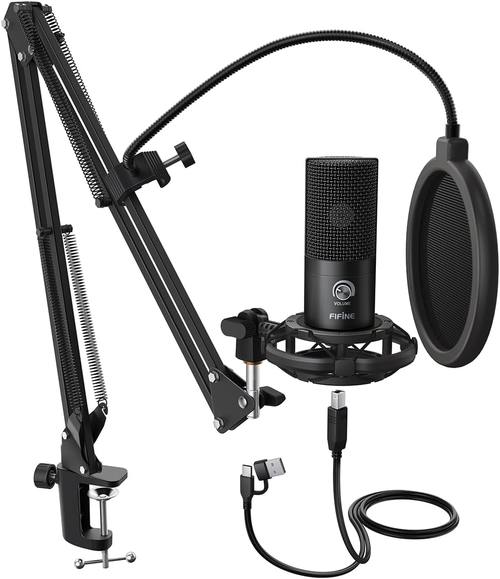
The Best Pick for a Quiet Room: FIFINE T669
The T669 is a USB studio condenser, and the word studio is doing real work in that name. A condenser captures more detail and a more open top end than a dynamic, and it does it without you having to sit quite so close to the capsule. In a room that is already soft, that sounds expensive.
In a room that is not soft, it sounds like your room. A condenser hears the reflection off the wall behind you, the window in front of you, and the hallway door you left open. I have heard more episodes ruined by a condenser in a bare bedroom than by any other single piece of gear.
So this is the pick for the person who already records in a closet full of clothes, or a bedroom with a rug, a couch and a bookshelf, or a corner with a moving blanket behind the mic. If that is you, the T669 gives you a fuller voice with less effort than a dynamic. If your room echoes when you clap your hands, buy the dynamic above instead and spend the difference on treatment.
Either way, budget for the accessories. A boom arm and a pop filter matter more than the next microphone up the line. I have heard a $300 mic ruined by a $15 desk stand, and I have heard a much cheaper mic sound genuinely good on a proper arm.
How I test every microphone
I record each mic twice, and the second recording is the one I trust. The first is in the treated room where I do voiceover, because I want to hear what the microphone can do. The second is in my untreated kitchen, because I want to hear what it will do for you.
Same script every time: a paragraph loaded with plosives, a paragraph of silence with nothing but the refrigerator and the street, and a paragraph read at three different distances from the capsule. Then I edit it the way I edit a client's show, with a high pass filter, a compressor and an EQ cut, because a mic that only sounds acceptable raw is not a mic you can work with at 11 p.m. on a deadline.
The spectrogram tells the story faster than my ears do. A condenser in a hard room shows up as a wash of reflected energy that sits under every syllable, and compression makes it louder. A dynamic in the same spot is narrower and drier, and the noise floor between phrases is lower.
I also live with each mic for a few weeks, because the failure mode of a cheap USB microphone is rarely the sound. It is the mount that sags after a month, the headphone jack that hisses, or a cable that picks up noise the moment the laptop charger goes in. Those things show up in week three, not in the first ten minutes.
What actually matters, in order
The room comes first. Then the distance between your mouth and the capsule. Then the mount. Then the gain staging. The microphone is fourth, which is an uncomfortable thing to write on a page about microphones.
Off-axis rejection matters more than frequency response for a home podcaster with a noisy street outside. A mic that ignores the side of the room is worth more than one with a flatter curve, because you cannot EQ out a car alarm and you cannot compress your way past a reflective wall.
USB microphones have closed most of the quality gap with the interface and XLR path. Five years ago, the sound described on this page cost several times as much plus an interface. The interface path is still the right answer for people who know why they need it: more inputs, better gain staging, a physical knob under your hand. If you do not know why you need it, you do not need it yet.
And the microphone you are not afraid to use beats the better microphone you keep in a drawer. A setup that takes four minutes to assemble is a setup you will abandon by episode six.
The microphone reference table
This is the table I keep on the studio wall, and it is the same one I fill in for every mic that comes through. Treat it as a starting point, not gospel. Your room and your voice will move things by a column.
| Mic | Connection | Room it tolerates | Where it wins |
|---|---|---|---|
 Visit on Amazon → FIFINE AmpliTank K688 Dynamic Microphone |
USB or XLR | Any room, including a loud one | One host at a desk, first mic, upgrade path later |
 Visit on Amazon → FIFINE T669 Studio Condenser USB Microphone |
USB | A soft room, closet or treated corner | Detail and openness on a quiet voice |
 Visit on Amazon → MAONO A04 USB Microphone, 192kHz/24Bit Condenser Mic Kit |
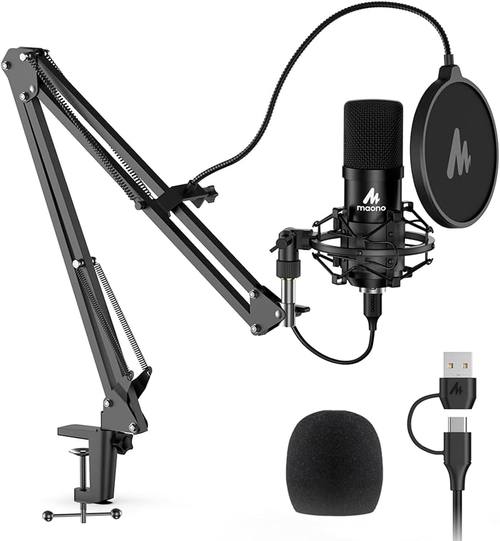
USB | A small soft room, nothing louder | Cheapest complete start, kit included |
 Visit on Amazon → DJI Mic Mini wireless system |
Wireless, receiver to camera or computer | Any room, any street, any sidewalk | Video, interviews, two people, travel |
The pattern in that table is simple. The further the capsule sits from your mouth, the more your room gets a vote. A mic clipped to your collar is close enough to ignore almost everything. A condenser on a desk three feet away hears the whole apartment.
MAONO A04 USB Microphone kit
The A04 is a condenser kit, and the kit is the point. The 192kHz/24Bit spec in the name is real, and it is also not the reason to buy it. You buy it because it is the cheapest complete path to recording: the microphone, the arm, the filter and the small parts that stop you from recording on a bare desk.
It is still a condenser, so the room rule applies without mercy. In a closet with clothes on both sides, the A04 punches well above its price. In an open living room with a television on in the next room, it will faithfully record the television.
Buy it if the budget is genuinely tight and you are willing to record in a small soft space. Do not buy it expecting the microphone to be the thing that fixes your sound.
DJI Mic Mini wireless system
The Mic Mini is the odd one out here, and it is the one I reach for when the job is video. Two transmitters, one receiver and a charging case, and the whole thing weighs less than the phone in your pocket.
The reason it sounds good is physics, not magic. A lavalier clipped to your shirt sits inches from your mouth, which means it barely hears the room at all. It is the most effective acoustic treatment you can buy, and you can carry it in a jacket.
That makes it the right tool for interviews, walking shots, two people on camera, and anyone who has been putting off video because of audio. It is not the right tool for a studio sound at a desk, and it is not the mic you leave plugged into your podcast rig. Different job, different table row.
Should you buy the FIFINE AmpliTank K688?
Yes, if you record one voice at a desk in a normal apartment. It is the mic I would hand a new podcaster first, because the room matters less to it, and because the XLR output means it stays useful when the setup grows. Get it on a boom arm, keep your mouth three or four inches away, and set the gain once.
Should you buy the FIFINE T669?
Yes, if your room is already soft and you want more detail than a dynamic gives you. Condensers reward a quiet space and punish a loud one, and no amount of editing fixes the second case. If you can clap your hands and hear the room answer, fix the room first or buy the dynamic.
Should you buy the MAONO A04?
If the budget is the deciding factor and you have a closet to record in, yes. It is a real microphone with a real kit around it, and the converter is not the bottleneck. Your room is the bottleneck, and it is free to fix with blankets you already own.
Should you buy the DJI Mic Mini?
Yes, if you shoot video and talk at the same time. Two transmitters and a charging case solve the two-person problem without a mixer, and wearing it is easier than setting up a desk mic. It is not a studio microphone and it does not pretend to be. It is the one that travels.